Rice Purity Test
The classic 100-question purity test about dating, sex, alcohol, drugs and rule-breaking. Tick everything you have done. Your Rice Purity score is 100 minus your ticks.
Mature topics. This test asks about sex, drugs and crime and was written for college students. Under 18? Take the clean Innocence Test or read this first.
Your score
Where your points went
Share your score
The card and the link show your score only, never your answers.
How the Rice Purity Test works
The Rice Purity Test is a 100-question self-graded survey. You tick what you have done, and your score is 100 minus the ticks: 100 means none, 0 means all of them. It comes from Rice University's student newspaper, which printed its first purity test in 1924.
People also call it the purity test, the rice test, the rice score quiz or the innocence test. Each of the 100 items reads after "Have you ever...". Tick the ones you have done, leave the rest. Not sure what one means? Tap the i next to it, or read every question explained. Every tick costs one point, so 100 means you have done none of them and 0 means you have done all of them. The list runs roughly from mild (holding hands, a first date) to far (things most people never do), which is why the number says something about how far down the list you have gone.
This is an independent version in our own words. The current original was written in 2012 by the Backpage editors of the Rice Thresher, Rice University's student newspaper, who rewrote the list to remove gender and sexuality bias and keep every item consensual[1]. We are not connected to Rice University or the Thresher. Our wording covers the same ground, so scores land close to the original.
What does your Rice Purity score mean?
There is no official scale. Ours is based on the order of the items, which run from mild to far. In short:
| Score | Range |
|---|---|
| 100 | Untouched |
| 99 to 90 | Barely started |
| 89 to 75 | Getting started |
| 74 to 60 | In the middle |
| 59 to 45 | Experienced |
| 44 to 30 | Seen a lot |
| 29 to 15 | Very experienced |
| 14 to 0 | Close to the bottom |
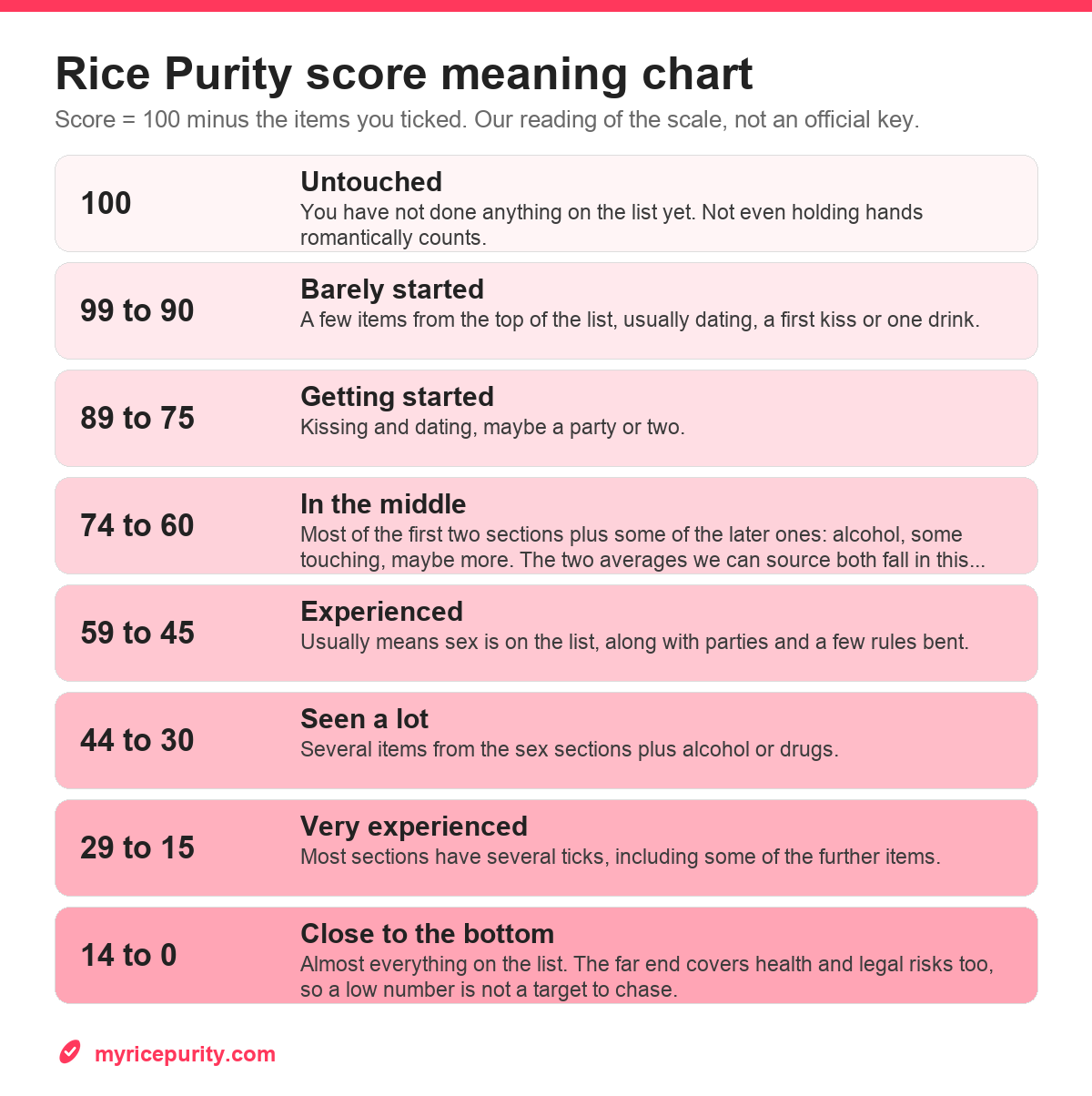
See Rice Purity score meaning for every range explained, a lookup for any score and a map of how the sections add up.
Rice Purity Test key facts
| What it is | A 100-item self-graded survey; score = 100 minus items ticked |
|---|---|
| Who publishes the original | The Rice Thresher, Rice University's student newspaper (ricepuritytest.com)[2] |
| First version | 7 March 1924: 10 questions, 119 women students, average 62[3][4] |
| 100-item format | From 1988[4] |
| Current Thresher list | Written by the Backpage editors in 2012[1] |
| Item 69 | A "?" since at least 1998[4] |
| MPS | Member of the preferred sex; replaced MOS by 1998[4] |
| Only sourced modern average | 65, Houston test takers, one day in August 2017[4] |
| Average by age | Not published by any source we could find |
Your answers never leave this page
The items are personal, so the test runs entirely in your browser. Answers are not written to your device, not sent to us, and no analytics event ever carries an answer or a score. The share card and the share link carry your score only. How privacy works here.
Where the test comes from
The Thresher printed its first purity test on 7 March 1924: ten questions put to 119 women students, who averaged 62[3][4]. The 100-item version appeared in 1988, the "?" at item 69 was there by 1998, and today's list dates from 2012[4]. The full history, with sources.
More tests
Guides
Frequently asked questions
What is the Rice Purity Test?
A list of 100 yes-or-no items about dating, kissing, sex, alcohol, drugs and rule-breaking. You tick what you have done and your score is 100 minus your ticks. It started at Rice University in Houston, where the student newspaper first printed a purity test in 1924.
Is the Rice Test the same as the Rice Purity Test?
Yes. "Rice test", "rice score" and "the purity test" are all names people use for the Rice Purity Test. Rice refers to Rice University in Houston, where the test comes from.
How is the score worked out?
Every item is worth one point. Start at 100 and lose one point for each item you tick. Ticking 30 items gives you 70. Nothing is weighted, so holding hands costs the same as anything further down the list.
Is this the official Rice Purity Test?
No. The current original was written in 2012 by the Backpage editors of the Rice Thresher, Rice University's student newspaper, and the Thresher publishes it at ricepuritytest.com. This is an independent version with the same structure and our own wording. We are not connected to Rice University or the Thresher.
Do you save or send my answers?
No. Your ticks exist only while this page is open. They are not stored on your device, not sent to us, and no analytics event carries an answer or a score. Close the tab and your answers are gone.
What is the average Rice Purity score?
Nobody publishes a reliable national average. The two figures with a real source are 62, the average of 119 Rice students in 1924, and 65, the average of Houston test takers on one day in August 2017, both reported by the Rice Thresher.
Is the test meant for teenagers?
It was written for college students and it asks about sex, drugs and crime. Plenty of high school students take it anyway. Our guide for teens and parents covers what to know before taking it.
Sources
- Anthony Lauriello, "Release of new purity test long overdue", The Rice Thresher, 17 August 2012. Link
- The Rice Purity Test as published by the Rice Thresher, ricepuritytest.com. Link
- "Rice Girls Not Quite Half Bad", The Thresher, Vol. 9, No. 22, 7 March 1924 (Rice University Digital Scholarship Archive). Link
- Emily Abdow, "Purity Test evolves, spreads beyond Rice", The Rice Thresher, 23 August 2017. Link